

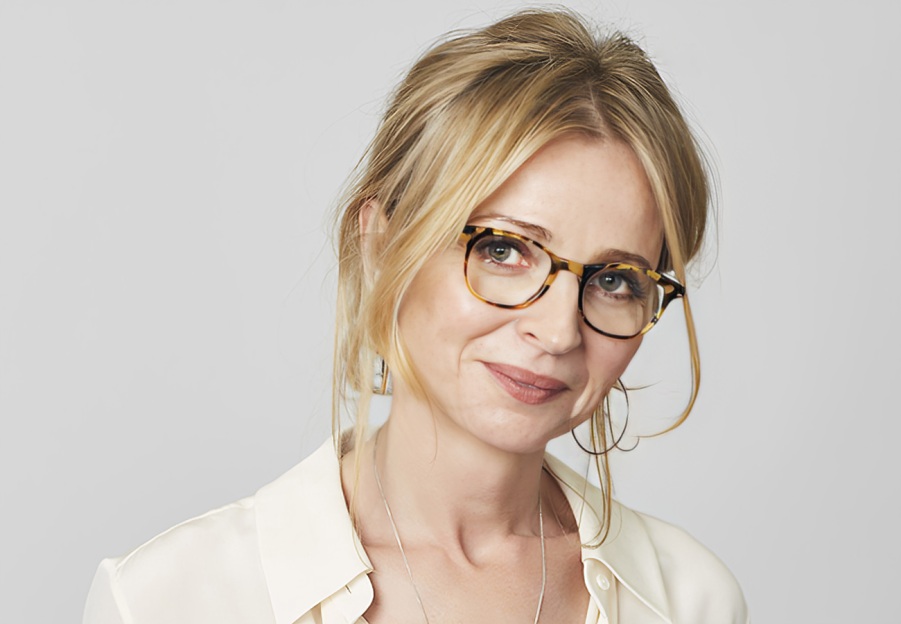
| Detail | Information |
|---|---|
| Full Name | Charlotte Edwardes |
| Born | 28 January 1973 (reported; not confirmed by primary record) |
| Nationality | British |
| Father | Retired Royal Navy commodore |
| Education | MFA in Creative Writing, New York University |
| Occupation | Journalist, columnist, feature writer |
| Publications | The Telegraph, Evening Standard, The Sunday Times, The Guardian, Vogue, Tatler |
| Current Role | Feature writer, The Guardian Saturday Magazine; contributor, The Sunday Times |
| British Press Awards | Three-time winner — Interviewer of the Year 2017, 2018; third win confirmed |
| Literary Agent | Eleanor Birne, RCW Literary Agency, London |
| Partner | Robert Peston — ITV Political Editor (together since 2017; public since 2018) |
| Children | Three (from previous relationship) |
| Net Worth | Not publicly disclosed |
Who Is Charlotte Edwardes
Charlotte Edwardes is a British journalist, columnist, and feature writer born on 28 January 1973, the daughter of a retired Royal Navy commodore. Over a career spanning more than two decades, she has become one of the most decorated interviewers in British print journalism — a three-time British Press Award winner whose long-form profiles have appeared in The Daily Telegraph, the Evening Standard, The Sunday Times, The Guardian, Vogue, and Tatler. She holds a Master of Fine Arts in Creative Writing from New York University, is represented for literary work by Eleanor Birne at RCW Literary Agency, and is the partner of ITV Political Editor Robert Peston.
The moment that brought her the widest public attention in her career arrived in October 2019, when her inaugural column for The Sunday Times Style described a 1999 Spectator lunch at which Boris Johnson — then editor of the magazine — had placed his hand on her thigh and squeezed it, and had done the same to the woman sitting on his other side. Johnson denied the allegation. Edwardes stood by it. The story dominated British political and media coverage for several days and placed her name, for the first time, on front pages rather than inside them. It was, in the context of a career built on illuminating other people’s stories, a sharp and involuntary reversal of roles — and she handled it with the same directness that characterises her journalism.
Family Background and Early Formation
Charlotte Edwardes grew up as the daughter of a retired Royal Navy commodore — a detail that places her upbringing within a specifically disciplined, public-service-oriented strand of British life that has nothing obvious in common with the world of newspaper journalism. The combination of structured military household and the intellectual freedom that a career in writing eventually afforded her is one of the more interesting contrasts in her biography, though she has spoken about it only obliquely in the public record.
Her route into journalism followed a period of advanced academic study. She earned an MFA in Creative Writing from New York University — an unusual credential for a British newspaper journalist of her generation, most of whom came through traditional reporting routes rather than American postgraduate creative programmes. The degree reflects a literary ambition that runs through her work: her profiles are constructed with a novelist’s attention to scene and character rather than the procedural efficiency of news reporting, and the MFA is part of the explanation for why.
She met Robert Peston, according to one account, at a Christmas party — the two had briefly overlapped at The Telegraph earlier in their respective careers without becoming close. By the time they met socially, Peston was a widower; his first wife Sian Busby, a writer, had died of lung cancer in September 2012. Edwardes, for her part, had three children from a previous long-term relationship and was, as Peston subsequently described it, someone who knew almost nothing about him — having been occupied with parenting during the years he had shot to national prominence through the BBC’s coverage of the 2008 financial crisis. They began a relationship in 2017. Peston revealed it publicly in September 2018, describing feeling guilty about falling in love again after his wife’s death. They are not married.
The Telegraph Years and a Reporter’s Foundation
Charlotte Edwardes began her professional career at The Daily Telegraph, where she spent approximately ten years as a writer and reporter — a substantial apprenticeship in one of Britain’s most prominent broadsheets. The Telegraph in the late 1990s and early 2000s was an environment that prized rigorous reporting and conservative editorial values, and working there across a decade gave Edwardes both the investigative instincts and the professional discipline that underpin her later feature writing.
During her Telegraph years she covered international stories including the Iraq War — the kind of front-line reporting that produces a fundamentally different relationship with material than desk-based journalism allows. She also worked at The Spectator during this period, the conservative political and cultural weekly that would later become central to the most publicly discussed episode of her career. It was at a Spectator lunch in 1999 that the alleged Boris Johnson incident took place — before the event became significant, at a time when she was simply a journalist at a media gathering attended by the magazine’s editor.
The awards she accumulated during her Telegraph and subsequent years reflect both the range of her reporting and the quality of her interviewing. She won the British Press Award for Investigative Reporting during her Telegraph tenure, and the Interviewer of the Year award — the most personally associated with her public identity — twice in consecutive years, 2017 and 2018. She was highly commended in the same category in 2021 and 2025, and was shortlisted for the British Journalism Awards in 2025, suggesting a consistency of output across decades rather than a peak followed by decline.
Evening Standard: Chief Interviewer and Features Editor
After The Telegraph, Edwardes moved to the Evening Standard, London’s most prominent daily newspaper, where she served in two senior roles: Chief Interviewer and Features Editor. The dual title reflects the particular combination she had developed — a journalist who could both commission and shape a publication’s feature identity and produce its most high-profile individual interviews herself.
She also edited The Londoner, the Evening Standard’s daily political diary section — a role that placed her at the intersection of political journalism and the specifically London social world that the diary has chronicled for decades. The Londoner is one of British journalism’s more distinctive institutions: a gossip-adjacent political column that operates within the serious newspaper environment of the Standard and requires an editor who can hold both registers simultaneously. Edwardes’ tenure there is documented and adds a dimension to her public profile that her later feature writing identity does not obviously foreground.
Her departure from the Evening Standard in July 2019 preceded her move to The Sunday Times by a matter of months — a transition that brought her into the national Sunday broadsheet environment and gave her the column that would produce the Boris Johnson allegation within months of her arrival.
Key Career Milestones
| Period | Role | Publication |
|---|---|---|
| Late 1990s–2009 | Reporter, then feature writer | The Daily Telegraph |
| Various | Contributor | The Spectator, Vogue, Tatler |
| 2009–2019 | Chief Interviewer; Features Editor; Londoner editor | Evening Standard |
| 2017 | British Press Award — Interviewer of the Year | — |
| 2018 | British Press Award — Interviewer of the Year | — |
| 2019 | Columnist and feature writer | The Sunday Times / Style |
| 2019 | Boris Johnson thigh allegation column | The Sunday Times |
| 2021 | Highly Commended — Interviewer of the Year | British Press Awards |
| 2025 | Third British Press Award win | British Press Awards |
| 2025 | Shortlisted — British Journalism Awards | — |
| Current | Feature writer | The Guardian Saturday Magazine |
The Boris Johnson Column: What She Said and What Happened Next
On a Sunday in October 2019, Charlotte Edwardes published her inaugural column for The Sunday Times Style magazine. The piece was framed around the second anniversary of the MeToo movement and what, if anything, had changed in British professional life in the two decades since her own encounter. The encounter she described had taken place at a Spectator lunch in 1999. Boris Johnson — then editor of the magazine — had, she wrote, placed his hand on her thigh under the table and given it what she described as a double squeeze. When she mentioned it to the woman seated on Johnson’s other side, that woman replied that he had done the same to her.
Downing Street issued a denial: the allegation was untrue. Johnson himself, when pressed by ITV News Political Correspondent Paul Brand, said he had no memory of attending the event and that the allegation was not true. Edwardes responded to Sky News: “If the Prime Minister doesn’t recollect the incident, then clearly I have a better memory than he does.” Mary Wakefield — Dominic Cummings’s wife, who had also worked at the Spectator — issued a statement saying she was not the second woman referred to and that nothing of the kind had happened to her. The story dominated coverage for several days.
The timing was significant in multiple directions. Edwardes was Robert Peston’s partner, and Peston was ITV’s Political Editor — a position that required him to interview the Prime Minister. The allegation created an obvious professional difficulty: Peston was reported to have withdrawn from a scheduled interview with Johnson in the immediate aftermath of the column’s publication. The political context — Johnson was in the midst of the final phase of the Brexit showdown, attempting to force through a no-deal departure by October 31 — meant the story landed at the most febrile possible moment in British political life.
Edwardes was explicit in her column that she was not making the allegation as a political act. She wrote that she opposed no-deal Brexit fiercely but did not think throwing every available accusation at Johnson was good for political health. The allegation, she made clear, was being reported as fact — something that had happened to her — not as a weapon in a political argument. The distinction was important to her. Whether it registered with all readers was another matter.
Journalism, Style, and What Her Interviews Actually Do
The Boris Johnson story was the most prominent single moment of Edwardes’s public career, but it was not representative of what her career has primarily been. Her reputation was built on long-form interview profiles — a genre that requires a specific set of skills that are distinct from news reporting, investigative journalism, or opinion writing, and that very few journalists do consistently well.
Her approach, as described by colleagues and visible in the work itself, combines a reporter’s preparation with a willingness to pursue emotional and personal territory that more guarded interviewers avoid. She has described her method in terms of genuine curiosity — an interest in understanding what is actually happening behind a public face rather than confirming what an audience already thinks it knows. The resulting profiles, across publications from the Telegraph to the Guardian, have a quality that is unusual in British journalism: they tend to reveal something that the subject had not intended to reveal, without the subject feeling ambushed.
The MFA from New York University is part of the explanation — a literary education that trained her to think about scene, character, voice, and structure as compositional elements rather than journalistic conventions. Her pieces read more like essays than reports, which is both their strength and the reason they require the space that only magazine journalism currently provides.
She has also written about AI’s role in journalism, contributing to a Journalism.co.uk interview in which she described AI as useful for manual and repetitive tasks — transcription, data sorting, basic summaries — while arguing that storytelling, context, and nuance remain irreducibly human. The position is what one would expect from a journalist whose primary asset is precisely the human capacity for emotional intelligence and narrative construction that she exercises in her profiles.
Robert Peston and a Partnership Built on Parallel Worlds
The relationship between Charlotte Edwardes and Robert Peston is one of the more publicly documented partnerships in British media. Peston revealed it in September 2018 in an interview in which he described feeling guilty about falling in love after Sian Busby’s death — a statement of emotional directness unusual in British public life that generated both sympathy and extensive coverage. Edwardes has been visible at Peston’s public events since, and the couple shares a home in the Muswell Hill area of London where Peston has long lived.
Their professional worlds overlap without being identical. Both are journalists; both operate primarily in the British national media; both have navigated the specific pressures of high-profile careers in a small, interconnected industry. Peston’s father was Labour life peer Lord Maurice Peston; his mother is historian Helen Conford. His son Maximilian is from his marriage to Sian Busby. Edwardes’s three children, from her previous long-term relationship, are not named in the public record.
The Boris Johnson episode placed the professional overlap in sharp relief. Peston had been a consistent and occasionally pointed critic of Johnson’s political conduct; Edwardes’s allegation, published in her own column in a separate publication, created a situation in which their personal lives directly intersected with his professional responsibilities. His handling of it — withdrawing from the scheduled interview, allowing Edwardes to speak for herself to other outlets — was widely noted as the correct response to an impossible position.
An Interviewer Whose Best Work Is the Permanent Record
Charlotte Edwardes is one of the more distinctive voices in contemporary British journalism — a feature writer whose interview profiles have set a standard for the genre in print, and whose own accidental entrance into the news cycle in 2019 demonstrated both the courage to say what she knew and the precision to say exactly what she meant. Three British Press Awards across nearly a decade, highly commended nominations in the years between, and a shortlisting for the British Journalism Awards in 2025 constitute a body of professional recognition that is rare in the career of any journalist. The Boris Johnson allegation generated more immediate public attention than any of them. Whether it generated more lasting significance is a question that only the full record of her career — still being written — will eventually answer.
