

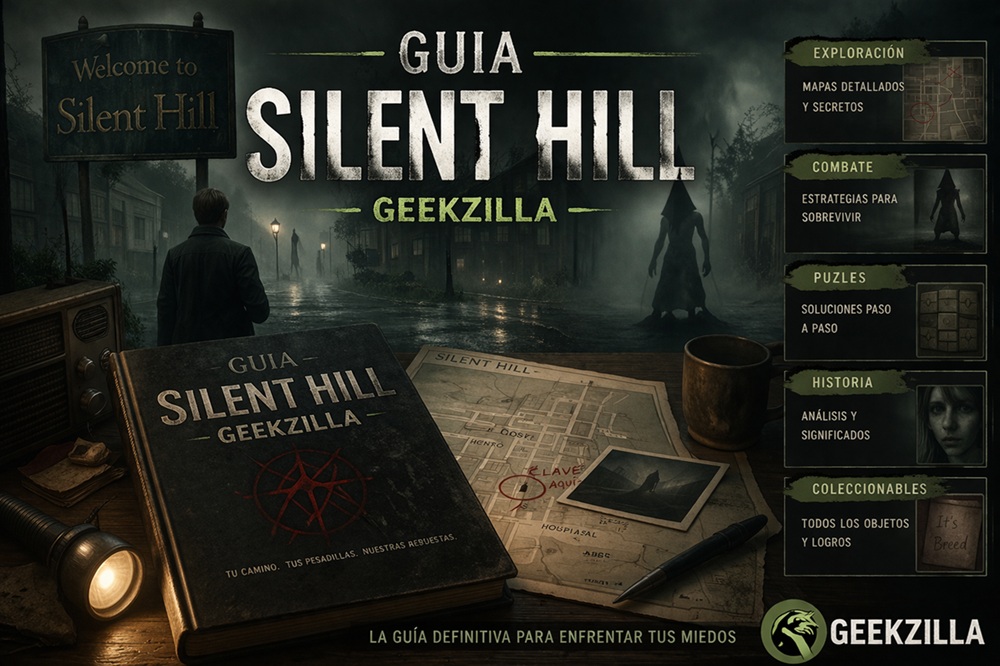
Silent Hill is not just a video game franchise. It is one of the most psychologically complex, emotionally devastating, and artistically ambitious horror experiences ever created. Since its debut in 1999, it has haunted players in ways that most games never attempt. The fog-drenched streets, the distorted monsters, the eerie silence broken only by Akira Yamaoka’s unforgettable score — Silent Hill gets under your skin and stays there.
But Silent Hill is also a series that many players find difficult to fully understand. The symbolism is layered. The narratives are fragmented. The monsters mean something. The endings change depending on choices you may not realize you are making. This is exactly why the Guia Silent Hill Geekzilla has become such a valued resource among the horror gaming community.
This guide explains what Guia Silent Hill Geekzilla is, why it matters, and then delivers exactly what it promises — a comprehensive, deep-dive walkthrough of the entire Silent Hill universe, from its origins to its newest entries, covering gameplay survival tips, monster symbolism, puzzle strategies, character analysis, multiple endings, and everything a new or returning player needs to experience the series to its fullest.
What Is Guia Silent Hill Geekzilla?
The word “guia” is Portuguese and Spanish for “guide.” Geekzilla is an online platform built around geek culture — gaming, horror, sci-fi, comics, and everything in between. When the two come together, the result is a Geekzilla-style guide to Silent Hill: something that goes far beyond a basic walkthrough and becomes a full interpretive companion to the series.
A standard walkthrough tells you where to go and what to do. A Guia Silent Hill Geekzilla does something different — it tells you why. Why is this monster here? What does this location symbolize? Why does the ending change based on how you played? What is the deeper meaning behind the story you just experienced?
This approach exists because Silent Hill is intentionally designed to resist easy explanation. The developers at Team Silent built the original games with a philosophy rooted in ambiguity, psychological discomfort, and symbolic storytelling. The fog was not just an atmospheric choice — it was a deliberate mechanic to limit what players could see, creating a constant sense of dread and uncertainty. The monsters were not random. The story is not linear in the way most games present narrative. Understanding Silent Hill requires a different kind of guide, and that is precisely what the Geekzilla-style approach delivers.
Why Silent Hill Is Different from Other Horror Games
Before getting into the guide itself, it is worth understanding what makes Silent Hill so unique among horror games — and why so many players seek out deeper explanations after playing.
Most horror games use fear as a surface-level tool. Jump scares, sudden loud noises, grotesque imagery — these techniques create a reaction but not necessarily a lasting impression. Silent Hill takes a fundamentally different approach. The fear it creates is existential and psychological. You are never entirely sure what is real within the game’s world. The environments shift and decay. The logic of the world follows the inner life of the protagonist rather than the rules of physical reality.
The series is deeply influenced by psychological horror literature and film, particularly works that explore guilt, grief, trauma, and repression. Playing a Silent Hill game without understanding these themes is like watching a film like Jacob’s Ladder without knowing anything about post-traumatic stress — you can follow the surface events, but you miss most of what the work is actually about.
This is the gap that Guia Silent Hill Geekzilla fills. It gives players the interpretive framework to understand what they are experiencing, which paradoxically makes the horror more effective rather than less. When you understand that the monsters are manifestations of a character’s specific psychological wounds, every encounter becomes more personal and more disturbing.
The Complete Silent Hill Series: Every Game Explained
The Silent Hill franchise spans over two decades and includes mainline titles, spin-offs, remakes, and mobile games. Here is a complete overview of every significant entry in the series, in the order that best serves both newcomers and returning players.
Silent Hill (1999) — Where the Nightmare Begins
The original Silent Hill introduced the world to the fog-covered American town that would become one of gaming’s most iconic locations. Players follow Harry Mason, an ordinary man who crashes his car near the town of Silent Hill while traveling with his young daughter Cheryl. When Cheryl disappears in the crash, Harry ventures into the town to find her and discovers a world that has fractured between a mundane reality and a monstrous, blood-soaked nightmare dimension.
The first game establishes the series’ core mythology: the town of Silent Hill has a dark history tied to a religious cult, an ancient god, and a girl named Alessa Gillespie whose suffering has torn the fabric of reality. The themes of grief, religious fanaticism, and the corruption of innocence run throughout the narrative. The game’s puzzle design is tied to the story, and the environments — an elementary school, a hospital, a shopping mall — are all distorted reflections of the town’s history and the protagonist’s fears.
For newcomers, the original Silent Hill remains a foundational experience, though its technical limitations are significant. Players who want the most accessible entry point are often directed to Silent Hill 2 first, returning to the original after developing an appreciation for the series’ language.
Silent Hill 2 (2001) — The Pinnacle of the Series
Silent Hill 2 is widely regarded not just as the best game in the series but as one of the greatest horror games ever made. Many consider it a genuine work of art. The game follows James Sunderland, a man who receives a letter from his wife Mary — despite the fact that Mary died of illness three years earlier. The letter tells James to meet her in their “special place” in Silent Hill, and James drives to the town to find out what is happening.
What James discovers over the course of the game is not a supernatural mystery in the traditional sense. It is a story about guilt, repression, grief, and the human capacity for self-deception. The entire world of Silent Hill 2 is shaped by James’s subconscious mind. Every monster, every environment, every encounter is a manifestation of psychological truths that James is not yet ready to face.
Silent Hill 2 features multiple endings, each revealing a different facet of James’s story depending on the player’s actions, decisions, and even subtle behaviors like how often the player looks at photographs and how much health they maintain. The game watches how you play and adjusts its interpretation of James’s character accordingly. This is storytelling mechanics at their most sophisticated.
The game was remade in 2024 by Bloober Team for PlayStation 5 and PC. The remake is widely praised for preserving the emotional core of the original while updating the visuals, combat, and presentation to modern standards. It is the best entry point for players discovering the series today.
Silent Hill 3 (2003) — Heather’s Nightmare
Silent Hill 3 is a direct sequel to the original game and follows Heather Mason, a teenage girl who turns out to be the reincarnation of Alessa Gillespie. The game begins in a shopping mall that shifts into a nightmarish alternate dimension and escalates from there. Heather’s journey takes her directly into the heart of the religious cult that haunted the original game, and the story ties together the unresolved threads of the first title.
Thematically, Silent Hill 3 explores identity, trauma, and the weight of a past that the protagonist did not choose. Heather is a compelling protagonist precisely because she resists the horror with a kind of sardonic toughness, even as the world around her disintegrates into nightmare. The game’s visual design is arguably the most disturbing in the series, and its soundtrack remains among the best Akira Yamaoka produced.
Silent Hill 4: The Room (2004) — Claustrophobia as Horror
Silent Hill 4 takes the series in an unexpected direction. The protagonist Henry Townshend wakes up to find himself sealed inside his own apartment, unable to leave. A hole in the wall leads to a series of nightmare worlds, each tied to the murders committed by a serial killer named Walter Sullivan. The game is divided between the relative safety of the apartment — which gradually becomes less safe as the game progresses — and the horrifying worlds beyond the hole.
Silent Hill 4 is often called the black sheep of the series, but it is a genuinely unsettling experience that rewards patient players. Its exploration of isolation, surveillance, and the violation of domestic space gives it a psychological weight that sets it apart. It is recommended after players have experienced the first three games.
Silent Hill: Origins (2007) — The Prequel
Originally developed for the PlayStation Portable, Origins serves as a prequel to the original game. It follows Travis Grady, a truck driver who rescues a young girl from a fire near Silent Hill and finds himself pulled into the town’s supernatural history. The game fills in significant backstory about Alessa Gillespie and the events that set the entire series in motion.
Origins is not as narratively ambitious as the core four titles, but it is a solid entry point for players who want deeper context for the original game’s mythology. Its melee combat system introduced a weapon durability mechanic that adds a survival dimension to encounters.
Silent Hill: Homecoming (2008) — Soldier in the Fog
Homecoming follows Alex Shepherd, a soldier who returns home to find his younger brother missing and the town of Shepherd’s Glen — connected to Silent Hill — descending into horror. The game shifts toward a more action-oriented combat style, which divided fans, but its story explores themes of family secrets, sacrifice, and the sins passed down through generations.
Homecoming drew visual inspiration from the Silent Hill film adaptation and features some of the most visually striking monster designs in the series. It is a flawed but worthwhile entry for players who want a more combat-focused experience.
Silent Hill: Shattered Memories (2009) — The Psychological Profiler
Shattered Memories is one of the most innovative games in the series and a fascinating experiment in adaptive storytelling. It is a reimagining of the original Silent Hill — Harry Mason is still searching for his daughter — but the game constantly analyzes the player’s behavior through questionnaires, environmental interactions, and even what items the player chooses to examine. Based on this psychological profile, the game adjusts character appearances, dialogue, monster designs, and the tone of the ending.
Shattered Memories removes combat entirely. Instead, players run from monsters through frozen, maze-like environments when the nightmare world appears. It is less about surviving enemies and more about understanding the story’s psychological architecture. For players interested in the series as an artistic experience, Shattered Memories is essential.
Silent Hill: Downpour (2012) — Redemption in the Rain
Downpour follows Murphy Pendleton, a prisoner being transferred to a new facility whose bus crashes near Silent Hill. The game emphasizes open-world exploration, side missions, and a combat system built around improvised weapons that break with use. Murphy’s story explores redemption, the consequences of past violence, and whether genuine change is possible for someone who has done terrible things.
Downpour is an imperfect game — performance issues at launch damaged its reception — but its story is genuinely moving and its open-ended approach to the town is one of the most interesting design choices in the series. Players who approach it with patience find more depth than its reputation suggests.
Silent Hill: The Short Message (2024) — Free and Accessible
Released for free on PlayStation 5 in 2024, The Short Message marks the series’ modern revival. It is a shorter, more focused horror experience that follows a young woman named Anita who finds herself in an abandoned apartment building tied to the suicide of a friend. The game tackles themes of social media pressure, self-worth, and mental health with a directness that is both confrontational and compassionate.
The Short Message does not feature combat and functions more as an interactive horror narrative. It is an ideal starting point for players who want a modern, accessible introduction to Silent Hill’s emotional approach to horror.
Silent Hill 2 Remake (2024) — The Series Reborn
Developed by Bloober Team in partnership with Konami, the Silent Hill 2 Remake is the most significant release in the franchise’s modern era. It recreates the original game with a fully three-dimensional over-the-shoulder camera, updated combat, completely rebuilt environments, and rerecorded dialogue and performances. The remake received widespread critical acclaim and is generally considered faithful to the source material while enhancing what made it great.
For players new to the series in 2025, the Silent Hill 2 Remake is the single best starting point. It delivers the full emotional and psychological impact of the original in a format that modern players can engage with comfortably.
Silent Hill: f (2025) — A New Chapter
Set in 1960s Japan, Silent Hill: f represents the most radical departure in the series’ setting and cultural context. The game moves the action away from the American town entirely and into a Japanese village, bringing with it a new protagonist, new mythology, and a new cultural lens through which to examine the series’ core themes of fear, guilt, and psychological horror. Early information positions it as a bold reinvention that preserves the series’ spirit while expanding its world significantly.
Understanding the World of Silent Hill
The Town Itself
Silent Hill — the town — is not simply a haunted location in the traditional sense. It is a place where the psychological state of its visitors manifests in physical reality. The fog that perpetually blankets the streets is not just atmospheric; it represents the obscuring of truth and the isolation of the self. The town exists in multiple states simultaneously: a mundane, if decayed, version of reality and a nightmarish Otherworld that emerges when the darkness within a character — or within the town’s history — becomes overwhelming.
The town’s history matters as well. Founded centuries ago and carrying a legacy of suffering rooted in cult activity, coal fires burning beneath the surface, and the prolonged torment of Alessa Gillespie, Silent Hill has developed a kind of consciousness. It draws people to itself. It shapes itself around their fears. It offers them, in its twisted way, a confrontation with the truths they have been avoiding.
The Fog World and the Otherworld
Players in Silent Hill navigate between two versions of reality: the Fog World and the Otherworld. The Fog World is Silent Hill stripped of its population, blanketed in mist, quiet and unsettling but navigable. The Otherworld — signaled by a screaming industrial siren — is a rust-covered, blood-soaked nightmare version of the same spaces, where the architecture itself seems to have been torn apart and reassembled by something malevolent.
The transition between these worlds is one of the series’ most effective horror devices. Familiar spaces become unrecognizable. Safe zones become death traps. The Otherworld does not follow consistent rules, which means players can never fully predict what they will find when the sirens sound.
Monster Symbolism: What the Creatures Really Mean
This is where a Geekzilla-style guide separates itself most clearly from a basic walkthrough. In Silent Hill, monsters are not random obstacles. They are symbolic projections — manifestations of psychological states, past traumas, repressed emotions, and specific fears belonging to the game’s protagonists. Understanding what each creature represents transforms encounters from frustrating obstacles into meaningful storytelling moments.
Pyramid Head (Silent Hill 2)
Pyramid Head is the most iconic creature in the Silent Hill series and one of the most symbolically rich monsters in gaming history. He is a massive humanoid figure wearing a triangular metal helmet, dragging an enormous blade, and appearing throughout Silent Hill 2 at seemingly random moments to attack, observe, or simply stand and watch James Sunderland.
Pyramid Head represents James’s need for punishment. James carries a guilt so profound and so deeply buried that his subconscious mind has generated an executioner — a figure whose entire existence is oriented around the infliction of suffering. He is not trying to kill James in the way a standard video game enemy tries to kill the player. He is pursuing James toward a reckoning. He will not be fully defeated until James is ready to confront the truth about what he has done. His presence throughout the game is Silent Hill’s most sophisticated piece of environmental storytelling.
Mannequin (Silent Hill 2)
The Mannequin is one of Silent Hill 2’s most visually disturbing creatures — two lower halves of a female body fused together at the waist, crawling and lunging toward James on its hands. It represents James’s distorted perception of women and sexuality, specifically tied to his relationship with Mary and the complex emotions of guilt, desire, and resentment that have built up over years of caring for a dying wife.
Bubble Head Nurse (Silent Hill 2)
The nurses that appear in Silent Hill 2 are warped female figures in hospital uniforms with grotesquely deformed heads that bulge and shift. They are clearly tied to James’s memories of visiting Mary in the hospital during her illness — memories that carried with them a complicated mixture of love, grief, resentment, and repressed desire. The nurses represent the sexualized trauma of that period in James’s life and the guilt attached to those emotions.
Grey Children (Silent Hill 1)
The Grey Children — small, knife-wielding creatures that appear in Midwich Elementary School — represent the corrupted innocence of children, specifically tied to Alessa’s experiences of abuse and terror within the educational system. They are small enough to feel wrong in a way that larger monsters are not, and their behavior is disturbingly aggressive for their apparent size.
Closer (Silent Hill 3)
The Closer appears in Silent Hill 3 and represents Heather’s fear of her own body and the violation of personal space and autonomy. It is a large, fleshy creature with elongated limbs, and its design communicates a deeply unsettling sense of physical wrongness. Like most Silent Hill monsters, understanding its symbolic function makes the encounter more disturbing rather than less.
Abstract Daddy (Silent Hill 2)
The Abstract Daddy is encountered in relation to Angela Orosco’s storyline in Silent Hill 2. Its design — two figures intertwined on a mattress-like frame — makes its symbolism uncomfortably explicit: it represents sexual abuse, specifically the abuse Angela endured. It is one of the most disturbing monsters in the series precisely because its meaning is so legible once understood.
Key Locations and What They Mean
Midwich Elementary School
The school in the original Silent Hill is not just a creepy location filled with monsters. It mirrors the protagonist’s emotional state and reflects the trauma of Alessa Gillespie, who experienced suffering within spaces that should have been safe. The corruption of educational spaces — places associated with childhood development and safety — is a recurring theme in the series. Schools in Silent Hill are never simply schools.
Brookhaven Hospital
Hospitals appear throughout the Silent Hill series and serve as consistent symbols of suffering, helplessness, and the clinical dehumanization of patients. In Silent Hill 2, Brookhaven Hospital is particularly loaded with significance given James’s history of visiting Mary during her illness. The hospital becomes a space where James must confront his memories of Mary’s deterioration and his own emotional responses to that period.
Lakeview Hotel
The Lakeview Hotel in Silent Hill 2 is the “special place” that Mary’s letter referenced. It is where James and Mary spent a happy time together before her illness. By the time James arrives, the hotel has decayed into a nightmarish version of itself. The contrast between what the location meant and what it has become is one of the game’s most emotionally effective storytelling choices.
The Otherworld Transitions
Every major location in Silent Hill has an Otherworld version that amplifies its symbolic meaning. The school becomes even more hostile. The hospital becomes a dungeon. The hotel becomes a tomb. Players who pay attention to the visual and environmental language of these spaces will find layers of meaning that reward close observation.
Survival Tips: How to Play Silent Hill
Mindset Before Mechanics
The most important survival tip in any Silent Hill game is to abandon the instincts that other horror games encourage. Silent Hill is not an action game. Combat is deliberately clunky and difficult, not because the developers failed to make it smooth, but because they wanted players to feel vulnerable and uncomfortable rather than empowered. Fighting every enemy you encounter is not a viable strategy. Avoidance, patience, and resource conservation are far more important than combat proficiency.
Managing Resources
Health items, ammunition, and melee weapons are all limited. In early areas, it is tempting to use resources freely because encounters feel manageable. Later areas are significantly more dangerous, and players who have depleted their supplies will struggle. Prioritize health items for moments when your health is genuinely threatened rather than as a precaution after minor damage. Save ammunition for enemies that cannot be avoided or evaded.
The Radio and Flashlight
The radio in Silent Hill emits static when enemies are nearby — even before those enemies are visible. Learning to read the static is one of the most important skills in the series. Loud, consistent static means an enemy is close. Intermittent static means something is in the area but not immediately adjacent. This mechanic allows players to prepare for encounters before they happen, which is critical to survival on higher difficulty settings.
Exploration and Observation
Silent Hill rewards thorough exploration more than almost any other horror series. Notes, diaries, environmental details, and item placements all contribute to understanding the story and unlocking secrets. Many of the game’s most significant narrative revelations are delivered through optional documents that players can miss entirely on a first run. Reading everything you find is not just good practice — it is the difference between completing the game and understanding it.
Puzzle Difficulty Settings
Most Silent Hill games allow players to set puzzle difficulty independently from combat difficulty. On lower puzzle settings, puzzles become simpler and more intuitive. On higher settings, they become genuinely complex and require careful attention to environmental clues. For players new to the series, starting with normal puzzle difficulty is recommended. The puzzles are an integral part of the experience and should not be skipped or solved through external guides on a first playthrough if the goal is full immersion.
Silent Hill 2 Puzzle Solutions: Key Examples
The Clock Tower Puzzle
Clock-based puzzles appear multiple times throughout the series and generally require players to read environmental clues — notes, paintings, or inscriptions — to determine the correct time setting. The solution is never handed to the player directly. The clues are embedded in the environment in ways that reward observation and note-taking.
The Hospital Plate Puzzle
In several iterations of the hospital sections across different games, plate or tile puzzles require players to arrange elements according to symbolic logic rather than obvious visual patterns. The correct arrangements are often hinted at through documents found elsewhere in the hospital that describe emotional states, medical conditions, or symbolic associations. These puzzles reward players who have read everything they have encountered.
The Zodiac and Number Puzzles
Number-based puzzles in Silent Hill often require players to cross-reference information from multiple sources found across different areas of the game. The solutions are internally consistent — the game never requires knowledge that has not been made available to the player — but the connections between clue and solution are deliberately non-obvious. Patience and thorough exploration are the primary tools for solving them.
Multiple Endings: How Your Actions Shape the Story
One of Silent Hill’s most sophisticated design choices is its multiple ending system, particularly in Silent Hill 2. The game does not ask you to make obvious story choices to determine your ending. Instead, it monitors how you play throughout the entire experience.
Factors That Influence Silent Hill 2’s Endings
The game tracks whether James reads Mary’s letter multiple times, suggesting he is clinging to her memory. It tracks how much time James spends looking at a photograph of Mary. It monitors how many health items James uses and how often he is at low health — factors that influence whether the game interprets James as subconsciously seeking death. It pays attention to how James interacts with Maria, a character who resembles Mary. All of these behavioral signals feed into the game’s calculation of which ending James receives.
The Main Endings of Silent Hill 2
The “Leave” ending is considered the most hopeful and is unlocked when James has demonstrated growth, understanding, and a willingness to move forward. The “In Water” ending represents James choosing self-destruction, and is unlocked when the game’s behavioral tracking suggests James has been moving toward this conclusion throughout the playthrough. The “Maria” ending occurs when James’s fixation on Maria — and through her, on his idealized memory of Mary — overrides his ability to confront the truth. The “Rebirth” ending requires the player to find a set of hidden items across a New Game Plus playthrough. The UFO ending is a humorous secret conclusion that requires a specific item.
The key insight is that the endings are not determined by a single choice at a critical story moment. They are the cumulative result of how you engaged with the entire game. This is Silent Hill 2’s most elegant piece of design.
Key Characters Across the Series
Harry Mason
Harry is the protagonist of the original Silent Hill and one of the series’ most humanly relatable characters. He is not a soldier, a detective, or a supernatural figure. He is an ordinary man who writes mystery novels and loves his daughter. His vulnerability in the face of Silent Hill’s horrors is precisely what makes him compelling. His story concludes in Silent Hill 3 through Heather’s journey.
James Sunderland
James is the most psychologically complex protagonist in the series. His story is constructed as a gradual revelation, with the player’s understanding of who James is and what he has done shifting continuously throughout Silent Hill 2. He is simultaneously a man deserving of sympathy and a man who has done something terrible, and the game refuses to simplify that tension.
Heather Mason
Heather — born Cheryl Mason, reincarnated as Alessa Gillespie — is the protagonist of Silent Hill 3 and one of the series’ most resilient characters. Her sarcastic, defiant response to the horrors around her makes her immediately distinctive, and her eventual confrontation with her own origins gives the game an emotional core that connects the series’ mythology to personal identity in profound ways.
Alessa Gillespie
Alessa is arguably the most important figure in the Silent Hill mythology. A girl who was subjected to ritual abuse by a religious cult and whose suffering is directly responsible for the tear in reality that created Silent Hill’s nightmarish dimension, Alessa haunts the entire series as both victim and the inadvertent architect of its horror. Understanding Alessa’s story is essential to understanding the first three games.
Pyramid Head
While Pyramid Head is technically a monster rather than a character, his symbolic significance elevates him to something more. He is James Sunderland’s guilt given physical form, and his presence throughout Silent Hill 2 is one of the most sustained and effective pieces of psychological horror storytelling in the medium. His appearances are unpredictable, his behavior is terrifying, and his meaning only becomes fully clear at the game’s conclusion.
The Music of Silent Hill: Akira Yamaoka
No guide to Silent Hill would be complete without addressing the music. Composer Akira Yamaoka created the soundscapes for the original four Silent Hill games and several subsequent entries, and his work is inseparable from the series’ emotional and psychological impact.
Yamaoka’s scores blend industrial noise, distorted guitar, ambient electronics, and fragile acoustic pieces in ways that are deeply unsettling and yet often achingly beautiful. Tracks like “Theme of Laura” from Silent Hill 2 are genuine works of art that hold up entirely outside the context of the games. The contrast between the tenderness of the melodic pieces and the abrasive horror of the noise compositions mirrors the series’ own emotional dynamic — beauty and terror coexisting in the same space.
For the 2024 Silent Hill 2 Remake, Yamaoka returned to collaborate on the score, and his involvement was widely cited as one of the reasons the remake succeeded in preserving the emotional tone of the original.
The Silent Hill Series and Its Influence on Horror
Silent Hill’s influence on horror gaming and storytelling more broadly is difficult to overstate. Its approach to psychological horror — using environment, narrative structure, and symbolic imagery rather than jump scares and gore — has influenced countless subsequent games, films, and works of horror fiction.
Games like Amnesia: The Dark Descent, Layers of Fear, SOMA, and Observer all draw on the Silent Hill template of horror rooted in psychological reality rather than supernatural threat. The Netflix series Stranger Things draws on similar ideas about alternate dimensions shaped by psychological states. The work of horror directors like Ari Aster explicitly acknowledges the debt owed to the kind of grief-and-guilt-driven horror that Silent Hill pioneered.
The series also demonstrated that video games were capable of genuine emotional and artistic ambition — that the medium could deliver experiences as psychologically complex and emotionally resonant as the best horror literature and cinema. This argument, which seemed bold in 2001 when Silent Hill 2 was released, now seems self-evident. Silent Hill helped make it so.
Frequently Asked Questions About Silent Hill
Which Silent Hill game should I start with?
For players in 2025, the Silent Hill 2 Remake is the ideal starting point. It is the most emotionally powerful and narratively complete entry in the series and stands largely independent of the broader mythology, meaning new players do not need prior knowledge to experience its full impact. After completing Silent Hill 2, players are well prepared to explore the original trilogy in release order.
Do Silent Hill games need to be played in order?
Not strictly. Most Silent Hill games tell largely self-contained stories. However, Silent Hill 1, 3, and Origins share a connected mythology centered on Alessa Gillespie and the cult, and playing them in order deepens the experience significantly. Silent Hill 2 and 4 are largely standalone. Shattered Memories is a reimagining of the first game rather than a sequel.
What is the Otherworld in Silent Hill?
The Otherworld is the nightmarish alternate dimension version of Silent Hill that manifests when the darkness within the town — or within a character’s psyche — reaches critical intensity. It is characterized by rusted surfaces, blood, industrial imagery, and distorted architecture. It is not a supernatural realm in the traditional sense but rather a psychological space made physical.
Why does Silent Hill 2 have different endings?
Silent Hill 2 monitors player behavior throughout the entire game — how often James looks at Mary’s photograph, how much health he uses, how he interacts with specific characters — and uses this data to determine which ending best reflects the James that the player’s choices have created. The endings are not triggered by a single decision but by the accumulated weight of the player’s entire playthrough.
Is Silent Hill: f connected to the original games?
Silent Hill: f is set in 1960s Japan and features an entirely new protagonist and setting, making it the most culturally and geographically distinct entry in the series. It is designed to be accessible as a standalone experience while carrying the series’ thematic DNA forward into a new cultural context.
What makes Pyramid Head so iconic?
Pyramid Head works as a horror icon because he combines visual distinctiveness with deep symbolic meaning. He is visually unforgettable — a massive figure with a triangular metal head dragging an enormous blade through rusted corridors. But what makes him truly terrifying is the understanding that he exists specifically as a manifestation of James Sunderland’s guilt. He is not simply a monster. He is James’s judgment of himself given physical form.
Final Thoughts: Why Guia Silent Hill Geekzilla Matters
Silent Hill is a series that demands engagement. It does not reward passive play. It is built for players who are willing to slow down, observe carefully, read every document they find, and think seriously about what the game is communicating through its environments, its monsters, and its story. Players who approach it this way find one of the most rewarding experiences in horror gaming history. Players who approach it as a straightforward action game are likely to find it frustrating and confusing.
The Guia Silent Hill Geekzilla philosophy exists to bridge that gap. It offers the interpretive framework that makes Silent Hill legible without removing the mystery that makes it extraordinary. Understanding that the monsters mean something does not make them less frightening. Understanding the multiple ending system does not diminish the emotional impact of the conclusion. Understanding the symbolic language of the environments does not reduce their atmospheric power. In each case, understanding enhances the experience.
Whether you are walking into the fog for the first time or returning to a series you have loved for years, this guide is designed to ensure that your time in Silent Hill is everything the series is capable of being — terrifying, emotionally devastating, deeply meaningful, and utterly unforgettable.
The siren is sounding. The Otherworld is shifting. Step into the fog — and this time, understand what you are walking into.
