

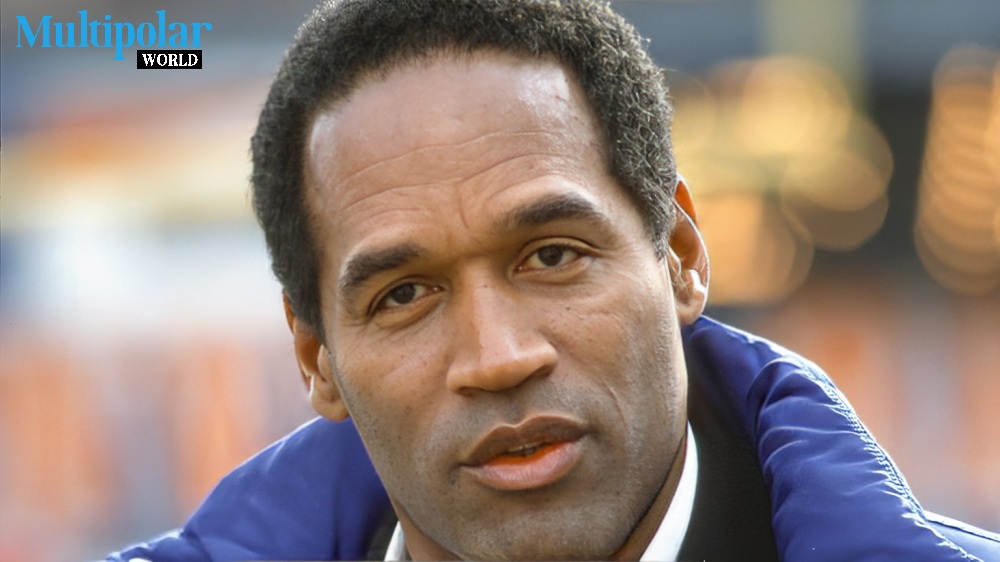
| Quick Facts | Details |
|---|---|
| Full Name | Orenthal James Simpson |
| Nickname | “The Juice” |
| Date of Birth | July 9, 1947 |
| Birthplace | San Francisco, California, USA |
| Date of Death | April 10, 2024 |
| Place of Death | Las Vegas, Nevada |
| Age at Death | 76 years old |
| Cause of Death | Prostate cancer |
| High School | Galileo High School, San Francisco |
| College | San Francisco City College (1965–66); USC — Heisman Trophy 1968 |
| NFL Teams | Buffalo Bills (1969–1977); San Francisco 49ers (1978–1979) |
| Draft | 1st overall pick, 1969 NFL Draft |
| Career Rushing Yards | 11,236 — 2nd all-time at retirement |
| 1973 Record | 2,003 rushing yards — first player to break 2,000 yards in a season |
| Hall of Fame | Pro Football Hall of Fame, 1985 |
| First Wife | Marguerite Whitley — married 1967; divorced 1979 |
| Children (Marguerite) | Arnelle (b.1968); Jason (b.1970); Aaren (b.1977; drowned 1979) |
| Second Wife | Nicole Brown — married February 2, 1985; divorced 1992 |
| Children (Nicole) | Sydney (b.1985); Justin (b.1988) |
| Murder victims | Nicole Brown Simpson and Ron Goldman — June 12, 1994 |
| Bronco chase | June 17, 1994 — 95 million viewers; Al Cowlings driving |
| Criminal trial verdict | Acquitted — October 3, 1995 |
| Civil trial verdict | Liable — 1997; $33.5 million damages |
| Las Vegas conviction | 2008 — kidnapping, armed robbery; up to 33 years |
| Parole | Released October 1, 2017 |
| Cancer diagnosis | Prostate cancer — confirmed February 2024 |
| Estate settlement | November 17, 2025 — ~$58 million to Goldman family |
| Net worth at death | ~$3 million |
There have been few figures in American public life whose biography contains as many distinct chapters — each complete enough to define an entire life on its own terms — as O.J. Simpson. He was one of the greatest running backs in the history of American football. He was a genuinely skilled comic actor whose timing and physical presence made the Naked Gun franchise significantly funnier than it had any right to be. He was the first Black man to headline a major American corporate advertising campaign. He was the defendant in the most televised murder trial in American legal history, acquitted by a jury that deliberated for less than four hours. He was found civilly liable for the same murders by a civil jury that took considerably longer to reach the opposite conclusion. He went to prison in his sixties for an armed robbery in a Las Vegas hotel room. He died of prostate cancer in Las Vegas in April 2024, at the age of seventy-six, while his estate was still being pursued by the family of one of the people a California criminal jury had decided, thirty years earlier, that he did not murder.
The story of O.J. Simpson is not one story. It is several stories simultaneously, and the difficulty of holding them together — the extraordinary athlete, the celebrity, the defendant, the convict, the dying man — is precisely the difficulty that his name continues to produce in anyone who thinks carefully about what it represents.
Potrero Hill and the Leg Braces: The Beginning
Orenthal James Simpson was born on July 9, 1947, in San Francisco, California, the third of four children born to Jimmy Lee Simpson and Eunice Durden. He grew up in the Potrero Hill neighbourhood — a working-class district on the south side of San Francisco, predominantly African-American in the years of OJ’s childhood, characterised by the specific combination of tight community bonds and limited material resources that shaped the upbringing of the generation of Black Americans born in the mid-1940s.
His father Jimmy Lee Simpson left the family early — OJ was five years old — and his mother Eunice raised the four children largely alone, working multiple jobs to provide the material stability her husband’s departure had removed. The specific difficulty of this period was compounded, in OJ’s case, by a physical condition: he developed rickets — a childhood bone disorder caused by vitamin D deficiency — that left his legs bowed sufficiently to require leg braces. He wore those braces until he was five years old.
The image of the boy who wore leg braces becoming the most dominant running back in American football history is one of the biographical details that OJ Simpson himself returned to frequently in interviews across his career — the specific improbability of the physical transformation, from the child whose legs required mechanical support to the athlete whose legs would set records that stood for decades. It is a genuine improbability, and it is one of the elements of his pre-crime biography that his later history makes difficult to engage with straightforwardly.
His father’s absence produced a specific gap in the household that was partially filled by an unlikely source: Willie Mays — the legendary San Francisco Giants centre fielder, who knew the family and took a mentoring interest in the young OJ, teaching him aspects of athletic discipline and focus that Eunice Simpson’s resources alone could not have provided. The Mays connection is a detail that OJ referenced in multiple interviews as formative — the famous man who gave time to a fatherless boy in Potrero Hill.
The gang affiliations of his early teenage years — he was a member of the Persian Warriors street gang — are documented in his own accounts and in biographical research as a period of his adolescence that he navigated toward sport rather than away from it, using the competitive framework that organised athletics provided as a structure that the absence of paternal authority and the presence of gang culture had not.
Galileo High School and the Road to USC
At Galileo High School — the San Francisco public school that also produced Joe DiMaggio, whose alumni list is one of the more remarkable in the American public education system — OJ Simpson’s football talent became evident in the specific way that high school football talent in California announces itself: through performances that travel quickly through the coaching networks that connect high school programmes to college recruiters.
It was at Galileo that he met Marguerite Whitley — his first wife — and where the social world of his adult life began to take shape. The football talent he developed at Galileo was sufficient to attract college interest, but the academic record that accompanied it was not sufficient for direct admission to a four-year university. He spent two years at San Francisco City College (1965–66) developing both his academic standing and his football statistics to a level that attracted the attention of the University of Southern California.
At USC, OJ Simpson became one of the most celebrated college football players in American history. In his two seasons as a Trojan — 1967 and 1968 — he averaged an extraordinary yards-per-carry figure, scored prolifically, and demonstrated the combination of speed, vision, and physical power that would define his professional career. In 1968, he won the Heisman Trophy — the award given to the outstanding college football player in the United States — with the largest margin of victory in the award’s history to that point. The USC years also brought him into contact with Al Cowlings — his closest friend, whose name would become attached to OJ’s biography in 1994 in circumstances that neither of them could have imagined in the late 1960s.
The Buffalo Bills and the 2,003-Yard Season
The Buffalo Bills selected OJ Simpson with the first overall pick of the 1969 NFL Draft — a selection that came with a contract worth $650,000 over five years, a record for a drafted player at that time. The first three seasons in Buffalo were, by the standards of what came later, unremarkable: the Bills were a poor team, their offensive line was insufficient to create the running lanes that a back of OJ’s capability required, and the statistical output of his first years in the league did not reflect the talent that the Heisman had promised.
The transformation came in 1972, when head coach Lou Saban was replaced and the Bills restructured their offensive approach around OJ and a dramatically improved offensive line — a group that became known, with the specific affection of Buffalo sports culture, as “The Electric Company” (because they turned on The Juice). The 1972 season produced the first of OJ’s six consecutive Pro Bowl selections. The 1973 season produced something unprecedented.
On December 16, 1973, in the final game of the regular season against the New York Jets at Shea Stadium, O.J. Simpson broke Jim Brown’s single-season rushing record of 1,863 yards and became the first player in NFL history to rush for more than 2,000 yards in a single season. He finished the season with 2,003 yards — a number that required the final game to complete, and that he reached with a 7-yard run in the fourth quarter that sent the Shea Stadium crowd into a reaction that the Buffalo Bills players, who were on the opposing team’s field, reported as genuinely extraordinary.
The 2,003-yard season established OJ Simpson as not merely a great running back but as a player whose relationship to the single-season rushing record was redefining what the position was capable of. He also set the record for most touchdowns in a season — 23 in 1975 — a mark that stood until 1983. He retired from the NFL in 1979 following two final seasons with his hometown San Francisco 49ers, with 11,236 career rushing yards — the second-highest total in history at the time of his retirement. He was inducted into the Pro Football Hall of Fame in 1985.
The Celebrity Years: Hertz, Hollywood, and the Brand
The commercial celebrity that OJ Simpson built alongside his athletic career was, in the specific context of American advertising and entertainment in the 1970s, something genuinely new. In 1975, Hertz rental cars hired him as their principal advertising spokesman — making him the first Black man to headline a major national corporate advertising campaign in the United States. The television commercials, which featured OJ running through airports in his distinctive style while a narrator tracked his speed and elegance, were among the most recognisable advertisements of the decade.
The Hertz campaign was the clearest expression of the specific version of crossover celebrity that OJ had developed: a Black athlete whose appeal to white middle-class consumers was, by the metrics of the advertising industry, unusually high. He was handsome, charming, physically extraordinary, and — by the careful construction of his public persona across the decade of his peak athletic fame — non-threatening in the specific way that the advertising industry of the 1970s required of Black celebrities whose target audience was primarily white.
His film and television career ran parallel to the advertising work. He appeared in The Towering Inferno (1974), the all-star disaster film; in Roots (1977), the landmark television miniseries; in Capricorn One (1978), the conspiracy thriller. His most commercially successful film appearances came in the Naked Gun comedy franchise — The Naked Gun: From the Files of Police Squad! (1988), The Naked Gun 2½: The Smell of Fear (1991), and Naked Gun 33⅓: The Final Insult (1994) — in which he played Detective Nordberg with a physical comedy timing and willingness to absorb slapstick punishment that made the character genuinely funny and demonstrated a comic capability that his dramatic work had not fully revealed.
The last of the Naked Gun films was released in March 1994. Three months later, he was arrested for murder.
Nicole Brown Simpson: The Marriage and the Violence
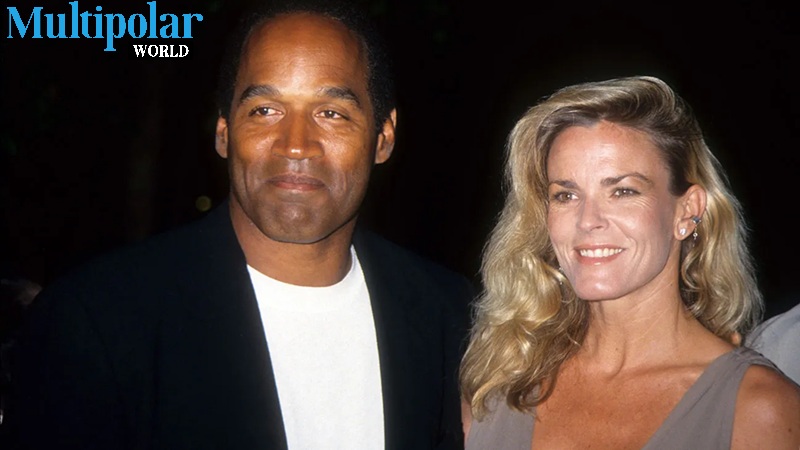
Nicole Brown was eighteen years old when she met OJ Simpson in 1977 — he was thirty, recently separated from Marguerite Whitley, and at the peak of his cultural celebrity. She was working as a waitress at a Beverly Hills nightclub. They began a relationship that would span nearly two decades, a marriage, two children, a divorce, and an aftermath of documented domestic violence that the prosecution in the 1995 criminal trial would place at the centre of its case.
They married on February 2, 1985, in a ceremony that took place after OJ’s divorce from Marguerite had been finalised and after Nicole had spent seven years in a relationship whose private dimensions were significantly at odds with the public presentation of the couple’s life. Sydney Brooke Simpson was born in October 1985; Justin Ryan Simpson was born in August 1988.
The domestic violence that characterised the marriage is documented in police records, in Nicole’s own diary entries, in photographs, and in a 911 call that was played to the jury at the 1995 criminal trial. Police were called to the Simpson residence eight times during the marriage for domestic disturbance incidents. The most serious documented incident occurred on December 31, 1989, when OJ beat Nicole severely enough that she required hospital treatment, and when she told the responding officer that she feared OJ would kill her. He pleaded no contest to the charge and received probation — a legal outcome whose modesty relative to the severity of the incident reflects the specific inadequacy of the domestic violence prosecution framework of that era.
Nicole filed for divorce in 1992, citing irreconcilable differences. The divorce was finalised that year. She and OJ continued to have contact — a complicated post-divorce entanglement whose specifics were extensively examined during the 1995 trial.
June 12, 1994: The Murders
On the evening of June 12, 1994, Nicole Brown Simpson and her friend Ron Goldman were found murdered outside Nicole’s condominium at 875 South Bundy Drive, Brentwood, Los Angeles. Nicole had been stabbed multiple times and nearly decapitated. Goldman had been stabbed and slashed across his body in a manner consistent with a prolonged struggle. Their bodies were discovered shortly after midnight by a neighbour walking her dog.
Nicole and OJ’s two children — Sydney and Justin, aged eight and five — were asleep inside the condominium at the time of the murders.
OJ Simpson was in Chicago when the murders were discovered, having flown there the previous evening for a Hertz corporate event. He was notified of Nicole’s death by telephone early on the morning of June 13. He flew back to Los Angeles. Los Angeles Police Department detectives, arriving at OJ’s Rockingham estate that morning to notify him of Nicole’s death, found what would become the central physical evidence in the case: a bloody glove behind his house that matched a glove found at the Bundy Drive crime scene, a trail of blood drops consistent with OJ’s DNA, and OJ’s own bloody footprints of a size 12 Bruno Magli shoe — a shoe type he had been photographed wearing but would deny owning.
OJ Simpson became a suspect immediately. He was asked to surrender to police on June 17, 1994. He did not.
June 17, 1994: The Bronco Chase
At approximately 6:30pm on June 17, 1994, an estimated 95 million Americans were watching television — many tuned to the NBA Finals between the New York Knicks and Houston Rockets — when coverage was interrupted by aerial footage of a white Ford Bronco moving slowly along the Los Angeles freeway system, followed at a distance by a convoy of LAPD vehicles.
The Bronco was being driven by Al Cowlings — OJ’s oldest friend, the man who had been dating Marguerite Whitley at USC when OJ first met her. In the back of the Bronco was OJ Simpson, who had a passport, a disguise kit, a loaded .357 Magnum handgun, and a letter he had written that morning that was read publicly by his friend Robert Kardashian — a letter that many who heard it interpreted as a suicide note.
The chase lasted approximately four hours, covering 50 miles of Los Angeles freeways before ending at OJ’s Rockingham estate, where he eventually surrendered after speaking by phone with police negotiators and with his mother. The crowds that gathered on overpasses along the route to cheer OJ — many holding signs reading “Go Juice Go” — were one of the more surreal images of an event that was, in its entirety, among the most surreal in American television history.
OJ was taken into custody and charged with two counts of first-degree murder.
The Trial of the Century: 1995
The criminal trial of O.J. Simpson — which began in January 1995 and concluded with the verdict on October 3, 1995 — is the most comprehensively documented legal proceeding in American history, and the most culturally significant. It was broadcast live on television. It produced ratings that exceeded those of most major entertainment programming. It consumed American public attention for nine months with an intensity that the news media had not previously encountered and has not fully replicated since.
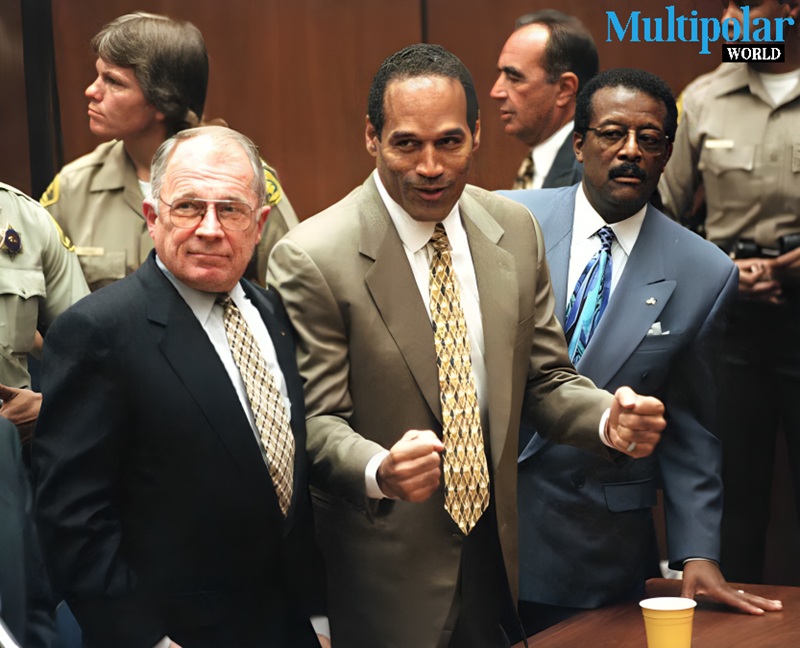
The defence team — known as the Dream Team — assembled a group of lawyers whose individual reputations and collective capability represented the most formidable criminal defence apparatus ever constructed for a single defendant: Johnnie Cochran, the most eloquent criminal defence attorney of his generation; Robert Shapiro, whose trial strategy and media management were crucial in the early stages; F. Lee Bailey, whose cross-examination of prosecution witnesses was among the most aggressive in the trial; Alan Dershowitz, the Harvard law professor who served as the appellate strategy architect; and Robert Kardashian, OJ’s personal friend who rejoined the California bar specifically to serve on the defence team.
The prosecution’s case, led by Marcia Clark and Christopher Darden, was built on DNA evidence — blood matching OJ’s DNA found at the Bundy Drive scene and in his Bronco and at his Rockingham estate — and on the documented history of domestic violence that the defence characterised as irrelevant to the specific question of the murders.
The trial’s defining moments were multiple and vivid. The glove demonstration — in which OJ was asked to try on the gloves found at the two crime scenes, and appeared visibly unable to fit them over his hands — produced Cochran’s most famous courtroom utterance: “If it doesn’t fit, you must acquit.” The prosecution subsequently argued that the gloves had shrunk from blood exposure and preservation in freezing conditions, and that OJ’s difficulty fitting them was exaggerated. The jury, watching the demonstration live, made their own assessment.
The testimony of Mark Fuhrman — the LAPD detective who found the Rockingham glove — was undermined by the revelation that he had told a screenwriter, on tape, that he had used racial slurs repeatedly over the preceding decade, directly contradicting his sworn testimony that he had not used the word in ten years. The tapes were played in court. Fuhrman took the Fifth Amendment rather than answer further questions. The defence argued that a racist police officer had planted evidence; the prosecution argued that the DNA evidence was incontrovertible regardless of Fuhrman’s character.
On October 3, 1995, the jury — which had deliberated for less than four hours after nine months of trial — returned a verdict of not guilty on both counts of first-degree murder.
The Racial Divide: What the Verdict Meant
The reaction to the acquittal was immediate, visceral, and divided almost entirely along racial lines in a way that made explicit a set of fractures in American society that the trial had been excavating throughout its nine months. Footage of the verdict being announced in offices, universities, and homes across the country showed Black Americans largely reacting with relief or celebration, and white Americans largely reacting with shock or anger — a split that polling data confirmed was not merely anecdotal.
The divergence reflected two genuinely different sets of experiences with the American criminal justice system. For many Black Americans, the acquittal represented a rare instance of the system failing to convict a Black man whose defence had demonstrated — through the Fuhrman tapes and through the broader argument about LAPD evidence-gathering practices — that the police investigation was tainted by racial prejudice. For many white Americans, the acquittal represented a wealthy man using his resources to avoid accountability for two murders that the DNA evidence had, in their assessment, proven beyond reasonable doubt.
Both reactions were, in their own terms, coherent. The trial had become the forum in which these two sets of experiences were tested against each other, and the verdict — whatever it meant about OJ Simpson’s guilt or innocence — was received primarily as a statement about which set of experiences the justice system would acknowledge.
The Civil Trial: $33.5 Million Liable
In February 1997 — sixteen months after the criminal acquittal — a civil jury found O.J. Simpson liable for the deaths of Nicole Brown Simpson and Ron Goldman. The civil standard of proof — preponderance of evidence, rather than beyond reasonable doubt — produced a different outcome from the same set of underlying facts. The jury awarded $33.5 million in compensatory and punitive damages to the families of the victims: $8.5 million in compensatory damages and $25 million in punitive damages.
OJ Simpson never paid the civil judgment in full. California law protected his NFL pension — approximately $25,000 per month — from seizure, and he moved to Florida, whose homestead exemption protected his residence from seizure. He lived in a Kendall, Florida home and played golf, and the Goldman and Brown families pursued the enforcement of the judgment for the remainder of his life.
On November 17, 2025 — more than a year after OJ’s death in April 2024 — his estate agreed to pay approximately $58 million to the Goldman family as a settlement of the outstanding civil judgment, representing the accumulated principal and interest of the original 1997 award.
Las Vegas, Prison, and the Final Years
On September 13, 2007 — thirteen years after the Bundy Drive murders and twelve years after his criminal acquittal — O.J. Simpson led a group of men into a room at the Palace Station Hotel in Las Vegas, where they confronted two sports memorabilia dealers at gunpoint and took items that OJ claimed were his own property that had been stolen from him.
The specific irrationality of the action — a man whose freedom was the most consequential legal outcome in American judicial history, risking that freedom over sports memorabilia — was noted by virtually everyone who commented on it. OJ maintained that he was simply recovering his own property and had not known that the other men in the room were armed.
In October 2008, a Nevada jury found him guilty on all twelve counts, including kidnapping and armed robbery. He was sentenced to 33 years in prison with the possibility of parole after nine years. He was incarcerated at the Lovelock Correctional Center in Nevada.
On October 1, 2017, the Nevada Board of Parole Commissioners granted OJ Simpson parole. He was released and moved to Las Vegas, where he lived in a house near the Rhodes Ranch Golf Club with his daughter Arnelle, played golf regularly, and maintained a low public profile until his health began to decline.
In May 2023, he announced publicly that he had been diagnosed with cancer, without specifying the type. In February 2024, it was confirmed as prostate cancer. He died at his Las Vegas home on April 10, 2024 — the anniversary, within a week, of the Bundy Drive murders thirty years earlier. He was cremated on April 17, 2024 at Palm Mortuary in downtown Las Vegas.
He is survived by his children Arnelle, Jason, Sydney, and Justin. Aaren, his youngest child with Marguerite Whitley, had drowned in the family swimming pool in August 1979.
Legacy: The Numbers and the Narrative
The legacy of O.J. Simpson exists in two irreconcilable registers simultaneously — the football register and the legal register — and the difficulty of holding both is the specific difficulty that his name produces.
The football register is unambiguous. The 2,003-yard season of 1973 was one of the great individual athletic achievements in the history of American sport. The Pro Football Hall of Fame induction of 1985 was deserved by the statistics and by the quality of play they represented. The Heisman Trophy was won by the best college player of his generation.
The legal register is equally unambiguous in its own terms. A criminal jury found him not guilty of two murders. A civil jury found him liable for those same deaths. A Nevada criminal jury found him guilty of kidnapping and armed robbery. He served nine years of a 33-year sentence. His estate settled a $58 million civil judgment in 2025.
The OJ: Made in America documentary (2016) won the Academy Award for Best Documentary Feature and provided the most comprehensive account of how the specific history of race in Los Angeles — the LAPD’s documented practices, the Rodney King beating and its aftermath — shaped the context in which the 1995 trial occurred. American Crime Story: The People v. OJ Simpson (2016) won nine Emmy Awards and introduced his story to a generation too young to have watched the original trial in real time.
| Career Statistics | Detail |
|---|---|
| Career rushing yards | 11,236 |
| Career rushing touchdowns | 61 |
| 1973 season rushing yards | 2,003 (record at time) |
| Single-season TD record (1975) | 23 |
| Pro Bowl selections | 6 |
| NFL seasons | 11 |
| Hall of Fame inducted | 1985 |
Conclusion
O.J. Simpson was born in San Francisco on July 9, 1947, wore leg braces as a child, became the most dominant running back of his generation, set records that stood for decades, became the most recognisable face in American corporate advertising, made movies and television programmes that millions of people enjoyed, was charged with the murders of two people, was acquitted by a criminal jury after the most watched trial in American history, was found liable by a civil jury for those same deaths, was convicted of armed robbery and kidnapping in a Las Vegas hotel room, served nine years in a Nevada prison, was released, played golf in Las Vegas, developed prostate cancer, and died on April 10, 2024, at the age of seventy-six.
His estate settled a $58 million civil judgment in November 2025. His children are alive. The people he was acquitted of killing are not. The country he divided with a single verdict has never fully resolved the division his trial exposed.
He was, by any honest accounting, one of the most gifted athletes the United States has ever produced and one of the most consequential defendants in its legal history. Holding both of those facts simultaneously — without collapsing them into each other or pretending either one cancels the other — is the specific work that O.J. Simpson’s biography demands of everyone who encounters it.
