

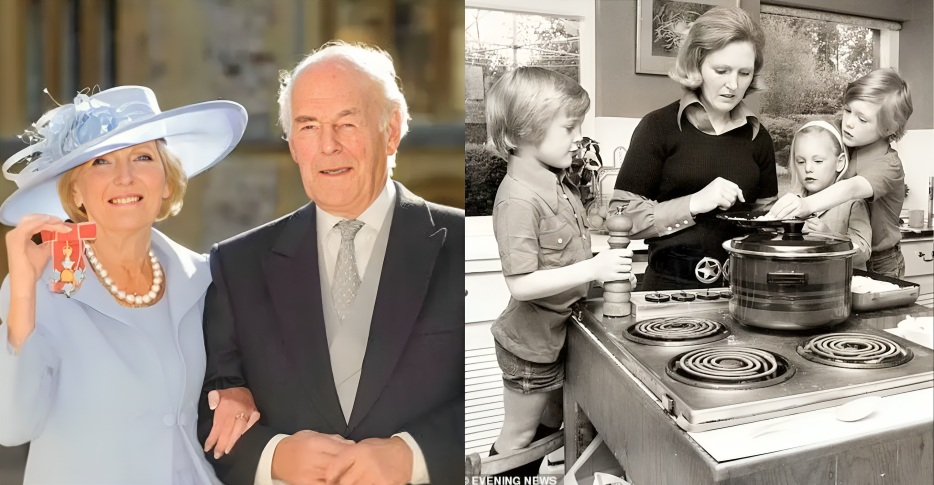
There are people who never seek public attention and yet become, through the circumstances of their lives and the people who loved them, part of the public record. William John March — born in 1969, died in January 1989, nineteen years old, studying business at Bristol Polytechnic, home for a weekend visit when a borrowed car skidded on ice in Buckinghamshire — is one of those people. His name appears in search queries not because he pursued recognition but because his mother, Mary Berry, one of Britain’s most genuinely beloved public figures, has spoken about his loss with a consistency and an openness that has helped many thousands of other bereaved parents feel that their own grief is not invisible, not shameful, and not something to be buried.
| Quick Facts | Details |
|---|---|
| Full Name | William John March Hunnings |
| Born | 1969, Paddington, London |
| Died | January 1989, near Coleshill, Buckinghamshire |
| Age at Death | 19 years old |
| Nationality | British |
| Mother | Mary Berry — baking icon, TV presenter, author (born March 24, 1935) |
| Father | Paul John March Hunnings — retired antiques dealer; married Mary Berry 1966 |
| Siblings | Thomas Alleyne March Hunnings (b. 1968) — tree surgeon, Oxfordshire; Annabel Mary March Hunnings (b. 1972) — chef, co-creator of The Mary Berry & Daughter range |
| Education | Bristol Polytechnic (now University of the West of England) — studying Business |
| Cause of Death | Road traffic accident — icy road conditions near Coleshill, Buckinghamshire |
| Sister in Accident | Annabel — passenger; survived unharmed |
| Mary Berry’s Response | Became patron of Child Bereavement UK; annual tributes; ongoing public advocacy |
| Mary Berry’s Faith Note | Christian faith described as “deepened” by the loss |
This is his story, told as completely and as accurately as the available evidence allows — with respect for what is verified, clarity about what remains uncertain, and recognition that a life of nineteen years can carry a legacy that outlasts the longest careers.
Mary Berry and Paul Hunnings: The Family He Was Born Into
To understand William John March is to understand first the family that shaped him — specifically his mother, whose public career has made the private details of their shared life visible in ways that would otherwise never have reached beyond the Berry household in Penn, Buckinghamshire.
Mary Berry was born on March 24, 1935, in Bath, Somerset. She is the daughter of Alleyne William Steward Berry, who served as Mayor of Bath, and Margaret Berry. Her early life included a bout of polio at thirteen that hospitalised her for three months and left a permanent physical mark — a vulnerability she has spoken about with characteristic matter-of-factness, noting that she looks “a bit funny” when rolling pastry but experiences no other practical difficulty. She trained at the Bath School of Home Economics and studied at Le Cordon Bleu in Paris, worked as food editor at Ideal Home magazine, published her first cookbook in 1966, and had built a substantial reputation in British culinary publishing before most people knew her face as well as her name.
In 1966, Mary married Paul John March Hunnings — a bookseller who later became an antiques dealer, and who has remained her husband for nearly sixty years. They met at university. Their marriage has been consistently described, including by Mary herself, as a partnership of genuine solidity — the kind that survives both public exposure and private tragedy. Together they settled in Penn, a village in Buckinghamshire, raising their family in what every account characterises as a warm, private, family-centred household where home cooking was not professional practice but daily love made edible.
Three children arrived between 1968 and 1972: Thomas Alleyne March Hunnings in 1968, William John March Hunnings in 1969, and Annabel Mary March Hunnings in 1972. Thomas would become a tree surgeon in Oxfordshire. Annabel would become a chef and eventual business partner of her mother’s, co-creating The Mary Berry & Daughter range of chutneys, dressings, and sauces sold through major British supermarkets. William would not live to discover what he might have become.
A Childhood in Penn: What Is Known
William was born in Paddington, London, in 1969, and grew up in Penn, Buckinghamshire — a quintessentially English village in the Chiltern Hills, the kind of place whose character is shaped by centuries of settled community life and whose pace is deliberately removed from the urgencies of city existence. The Berry-Hunnings household was comfortable without being extravagant, family-oriented without being insular, and grounded in exactly the domestic values that Mary’s professional career has always reflected: the conviction that cooking is care, that mealtimes are the architecture of family life, and that the table is where love is most consistently and practically expressed.
Mary has described William in interviews across three decades with a consistency that suggests the details are not curated for effect but recalled with genuine fidelity. He was bright. He was gentle. He was full of promise. He was close to his siblings — particularly to Annabel, his younger sister by three years, who would be in the car with him on the morning everything changed. He was the kind of young man who brought joy to a room without demanding attention — a quality that, in Mary’s telling, feels as specific and as real as any biographical fact.
He was also, by his family’s account, a rugby enthusiast — a fact that has gained particular emotional resonance in the decades since his death. Mary has noted on more than one occasion that William’s nephew Hobie, Annabel’s son, plays rugby, and will sometimes come home from school saying: “I scored. William would have been proud, wouldn’t he?” The answer, in Mary’s telling, is always yes.
Bristol Polytechnic and the Business Studies He Never Finished
In 1988, William enrolled at Bristol Polytechnic — now the University of the West of England — to study business. He was eighteen years old, beginning a course that he had chosen for reasons his family describes as characteristic of his practical intelligence: he had no theatrical ambitions, no desire to follow his mother into the public world of food and television, and a clear-eyed interest in building a professional life of his own in a field that suited him. He was a student at Bristol Polytechnic for only a few months before his death.
The choice of business studies at a polytechnic in 1988 was, in the educational context of the time, a perfectly considered decision. British polytechnics in the late 1980s were rigorous vocational institutions — not the second-tier alternatives that snobbery sometimes painted them as, but genuine places of professional formation where students emerged with practical expertise and clear career trajectories. William’s choice says something about his character: grounded, purposeful, and uninterested in the kind of prestige that comes from the name on a diploma rather than from the quality of what you actually learn.
He had been at Bristol Polytechnic since 1988. In January 1989 — just months into his studies — he came home to Penn for a weekend visit.
The Weekend Visit: The Final Hours
The weekend of William’s death has been recounted by Mary Berry in multiple interviews, and the consistency of the details across those accounts — from a 2014 interview with Piers Morgan to a 2025 interview with Vogue — reflects the way that certain memories are not reconstructed each time they are spoken but simply played back, unchanged, because they have never faded.
William came home to Penn on a Friday evening. Mary had not seen him for several weekends and, as any mother would, had wanted to make his return feel special. She had prepared roast lamb — his favourite. The family ate together: Mary, Paul, Thomas, William, and Annabel. It was, by every account, an ordinary and happy evening. The kind of evening that only becomes precious in retrospect.
The following morning — a Saturday in January 1989 — William asked his parents whether he could borrow the family car. The reason was entirely mundane: he wanted to go into town to collect the weekend newspapers. Mary and Paul said yes. He left the house.
What happened next was reconstructed through subsequent police and family accounts. The January road conditions in rural Buckinghamshire were dangerous: ice had formed on roads that were, in ordinary weather, perfectly manageable. William was driving on those roads — with Annabel beside him in the passenger seat, having joined him for the errand — when the car lost traction. It skidded. The car struck a tree or, in some accounts, a lorry — the precise details vary slightly across sources, but all agree on the cause and outcome: icy road conditions, loss of control, fatal impact.
At approximately 1 p.m., the doorbell rang at the Berry-Hunnings house in Penn. Mary opened the door to find a policeman standing on her step.
“You just know,” she told Vogue in March 2025. The policeman told her there had been an accident. He told her William was dead.
Paul came home. They drove to the hospital together, through what Mary has described as endless corridors. Then, around a corner, Mary saw a pink tracksuit. Annabel — mud on her, but otherwise unharmed — running down the corridor toward them. The relief of seeing her daughter was immediate and real, even in the midst of the devastation of losing her son. “We’re very blessed that we’ve got Annabel and Thomas,” Mary told Piers Morgan in 2014. “But we don’t have William.”
At the hospital, Mary saw her son’s body. She has spoken about that moment with a directness that many find unbearable to read but that many bereaved parents have described as the first time they felt someone told the truth about what that experience is. “He just looked so beautiful and so lovely,” she told Vogue. “His little cold face.”
Grief, Faith, and the Decision to Keep Going
William John March’s death in January 1989 is the event against which the rest of Mary Berry’s public life must be understood. She was 53 years old. She was already a well-established figure in British food writing. She had two other children who needed her. She had a marriage of twenty-three years that would, she has since noted, need active protection from the kind of grief that, left unaddressed, ends marriages.
The way she navigated the aftermath of William’s death has been described differently in different contexts, but several threads run consistently through every account. The family pulled together. Mary and Paul made a deliberate decision to stay busy — to keep going, not as a suppression of grief but as a way of not disappearing inside it. Mary’s Christian faith, which she has described as being “deepened” rather than destroyed by the loss, provided a framework: the belief that she and William would be reunited gave her, she has said, “a reason to go on and be strong” in the immediate aftermath and in the decades that followed.
She has also been honest about the warning signs she observed in others. Grief kept entirely private, she has said, can “end in divorce.” The Berry-Hunnings marriage did not end. Paul and Mary are still together, approaching sixty years of marriage, their bond shaped by everything they survived together as much as by everything they celebrated.
Child Bereavement UK: Turning Loss Into Legacy
Perhaps the most tangible expression of William John March’s continuing influence on the world he left is Mary Berry’s work as patron of Child Bereavement UK — a charity that supports families who have lost a child, and children who have lost a parent.
Mary became involved with the charity specifically because of William’s death, and her patronage is not nominal. She has participated in campaigns, spoken at fundraising events, appeared in emotional televised appeals, and used her considerable public platform to ensure that the charity’s work reaches people who might otherwise not know it exists. In a 2017 campaign, she was asked what she would do if she could have one more minute with William. Her answer was simple and completely in character: “I would thank him for being a brilliant son.”
She has visited William’s grave on television — in The Mary Berry Story, broadcast in 2020, viewers watched as she stood at his grave and spoke about him with the combination of visible grief and evident grace that has made her handling of this loss something that many bereaved parents have found genuinely helpful. The response from viewers — comments about “crying my heart out” — reflects how powerfully her openness resonates.
She has also offered specific, practical advice on how to support people who are grieving — advice that could only come from someone who has experienced grief at this depth and paid close attention to what helped and what didn’t. Her consistent recommendation is to reach out not at the funeral, when support is plentiful, but weeks and months later, when the crowds have gone and the isolation has set in.
What William Means to the Family Now
Thirty-five years after his death, William John March remains an active presence in the Berry-Hunnings family’s daily emotional life — not as a source of unresolved pain but as a presence that continues to be honoured through conversation, through memory, and through the rugby scores his nephews bring home from school.
Thomas, 57, lives and works in Oxfordshire as a tree surgeon — a profession that has the same relationship to the outdoors that Mary has credited as one of her own sources of comfort after William’s death. Annabel, 55, has built a culinary career that mirrors and extends her mother’s, including the commercial collaboration of The Mary Berry & Daughter range. Both survived a childhood that included a tragedy that broke open the family and then, slowly, was integrated into it.
Mary Berry turned 90 in March 2025. In her Vogue birthday interview, she reflected on William’s death with the same honest simplicity she has always brought to the subject. “It’s absolutely amazing in my 90th year to think that William died all that time ago,” she said. And then: “Every family has disasters. This was our tragedy. It was a huge tragedy, but we did have two more children. We always think we were fortunate to have had him for 19 years.”
The grandchildren — five of them — know about William. They talk about him. The boys who love rugby invoke his name when they score. His absence is made present, regularly and naturally, in exactly the way that Mary has always said grief works best: not buried, not performed, but kept alive through ordinary speech and ordinary love.
Conclusion
William John March was born in 1969 in Paddington, London, grew up in Penn, Buckinghamshire, in a household shaped by his mother’s extraordinary warmth and his father’s quiet steadiness, and was killed in an icy road accident in January 1989, at the age of nineteen, on a Saturday morning when he had gone to collect the weekend newspapers. He studied business at Bristol Polytechnic. He loved rugby. He was described by everyone who knew him as bright, gentle, and full of promise. He was the son his mother has never stopped missing and never stopped honouring.
His legacy is not measured in professional achievements or financial accumulation. It is measured in the thousands of bereaved parents who have found, through Mary Berry’s openness about losing him, the permission to speak about their own losses. It is measured in the work of Child Bereavement UK, which her patronage has helped sustain and make visible. It is measured in the moments when a rugby-playing nephew comes home from school and says William would have been proud.
He would have been 56 years old in 2025. He is nineteen, always.
